
“How would our life be different if we remember that every face we’re looking at wishes to be loved?”
– Chris Germer
As we continued our exploration of difficult emotions, shame was our topic for the week. After our soft landing and small-group check-in, we were joined by David Fredrickson, co-developer of the Self-Compassion for Shame course.
With David’s guidance, we explored shame as a universal human emotion that may hide beneath anger, fear, grief, perfectionism, people-pleasing, secrecy, avoidance, or repetitive behaviors. It’s is a form of self-attack that tells us to “go small, go silent, go away” and can activate fight, flight, freeze, or fawn responses.
Although none of us is exempt from shame and we cannot eliminate it entirely, we can begin to “de-shame” shame and change how we relate to it.
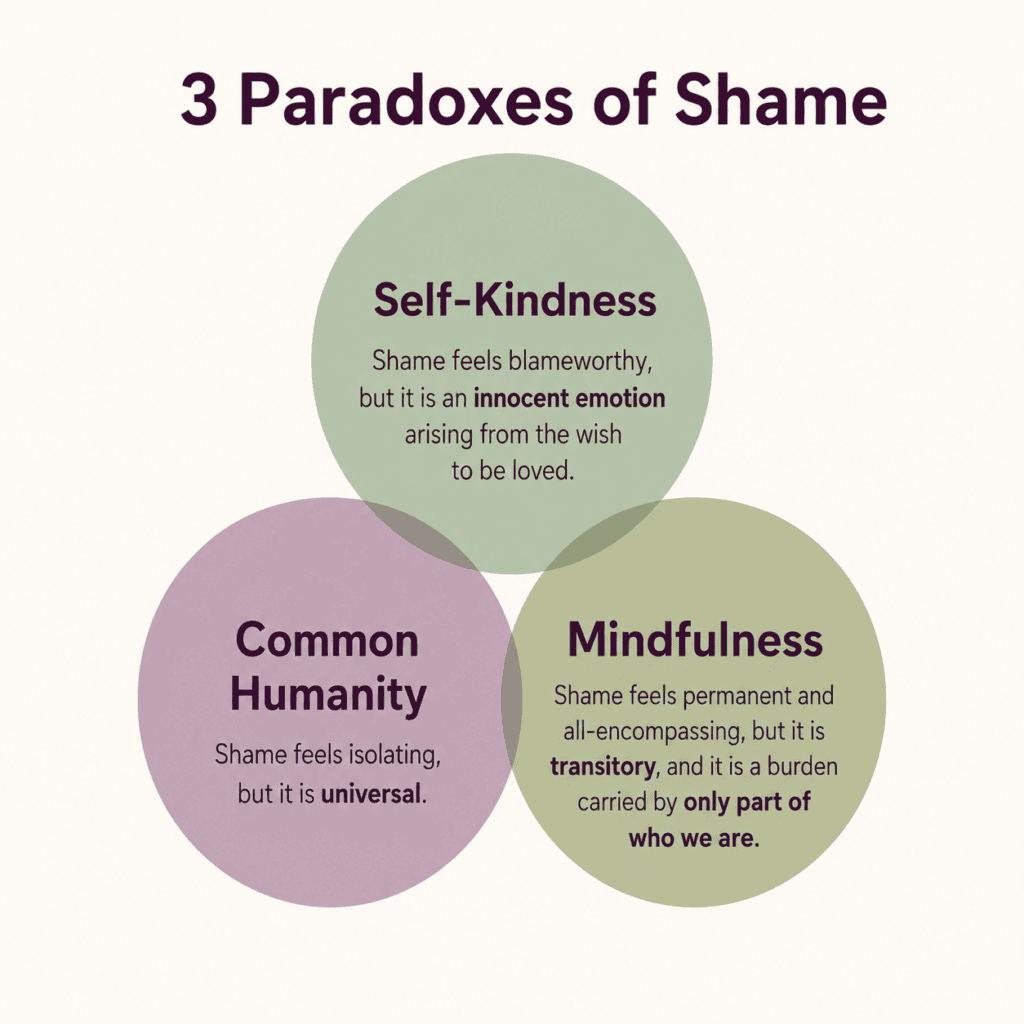
We explored three paradoxes of shame:
- Shame feels blameworthy, yet it is an innocent emotion arising from the wish to be loved.
- Shame feels isolating, yet it is a universal human experience.
- Shame feels permanent and all-encompassing, yet it is transitory—and only one part of our experience
David described self-compassion as an antidote to shame, not because it instantly makes shame disappear, but because it creates space and warmth around what hurts so that we are less immobilized by it.
- Self-kindness counters shame’s harsh self-judgment.
- Common humanity counters shame’s painful isolation.
- Mindfulness helps us recognize, “A part of me is feeling shame,” rather than becoming fused with, “I am bad.”
He also named curiosity as a close cousin of self-compassion. Curiosity gently moves us toward greater awareness about experience rather than away from it: What is happening here? Is there a vein of shame beneath this feeling? What am I afraid this experience says about me?
After the break, we explored a shame experience of our own through a brief writing exercise and sharing in small groups.
As you move through the coming week, we encourage you to notice when shame arises and asks you to become smaller, quieter, or less visible. Even gently recognizing, “This is shame,” can create a little breathing room. If it feels supportive, see whether you can bring curiosity to the experience and offer the part of you that feels ashamed some small kindness. Then simply notice what shifts.
The presence of shame does not mean that something is wrong with you, nor that you are destined to remain caught in its patterns. As we heard in class, much of what lives within us did not begin with us. As Krishnamurti observed, what we experience as our own thinking is often the thinking of our culture, shaped by our families, communities, histories, and inherited ways of making sense of the world.
Recognizing this allows us to take responsibility without blame: neither condemning ourselves nor locating all responsibility in our parents, ancestors, or the people around us. As Sebene Selassie reminds us, these patterns are unlikely to change without our intention and participation, but we can participate in their healing without adding more shame.
So keep returning to the truth of interconnection, to the present moment, and to your capacity to relate differently to what arises. Shame may have been here for a long time, but it is not the whole of who you are, and its patterns are not beyond change.
Housekeeping
- Amy will be back with us next week, August 10.
- Friendly reminder that our third rest week will take place August 17. No class.
Core Home Practice
- Formal Practice: (also very helpful as an on-the-spot informal practice): Self-Compassion Break for Shame, offered by Chris Germer (12 min. guided audio)
- Informal Practice: Notice when you’re having an experience of shame. How does it feel physically? Can you bring some care and attention to that in the moment? See what shifts.
Supplemental Practice
- Exercise: MSC Workbook: “Working with Our Negative Core Beliefs,” page 123-124.
Resources and Enrichment
- Book: Self-Compassion for Shame, by Chris Germer (on pre-order now, to be released October 2026)
- Course: Self-Compassion For Shame, available through the Center for Mindful Self-Compassion and other select locations
- Meditations from Kristin Neff:
- Practice: “Becoming a Compassionate Mess” (5:00)
- Practice: “Learning from Our Mistakes” (5:09)
- Practice: “Self-Compassion for Perfectionism” (9:59)
- Video teachings from Kristin Neff:
- “Working with Shame” (2:39)
- “Working with Cultural Shame” (8:27)
- “Self-Compassion and Shame” (9:14)
- “How Self-Compassion Helps Us Work with Shame” (4:39)
- “How Self-Compassion Addresses Addiction and Shame” (6:44)
- “How to Work with the Feeling That We Don’t Deserve Self-Compassion” (4:10)
- “Sharing Self-Compassion with Those Who Feel They Don’t Deserve It” (7:47)
- “Realizing Our Intrinsic Worth and True Nature When Society Rejects Us” (8:24)
- “The Protective Role of Self-Compassion for Bullying and Discrimination” (6:23)
- “Introducing Self-Compassion in Prisons: Overcoming Shame” (6:50)
- Video: Brown’s video on her B.R.A.V.I.N.G. model, which guides us in sharing our shame story with a person who is trustworthy and able to receive us with support, encouragement, and non-judgement. This discernment is critical when healing shame. (23 min.)
- Article series: By Rick Hanson: “From Shame to Self-Worth”
This week’s poem:
Honey I’m Home
Outside the sun sparkles Inside, a shadow that shouldn’t be
Moves on legs that don’t belong
Neither awake, nor asleep
“What’s wrong with me?” “This shouldn’t be.”
I fall before the altar of no
Prostrate, forgetting to breathe
Small, alone with tight gut
The ugly mean man
With small sharp words
Appears without invitation
Bangs his fist
“You are a failure.”
He unleashes the second arrow
And pierces my softest flesh
Bloodless and invisible
Shame without a name
Shuffling slippers in circles
On their way to where they began
Yet the sun still shines
And sealed eyes need only to turn
To feel the warmth of the light
Even a sliver will do
Breath remembers to breathe
Unclenched, my body finds room
And room and room and room
Space for all to belong, even him
The ground shakes
Tears fall like rain
With things I knew before I forgot
Honey, I’m home
by David Fredrickson, shared with permission